
No Facial Wrinkles, but The Reason You Look Old Lies in "Facial Volume"
There is a moment when you take a photo one day and it feels exceptionally unfamiliar. "Was my face always like this?" Your skin is not bad, but for some reason, it looks less lively, and although nothing has clearly changed much, there are times when your overall impression feels different from before. So, you naturally start to think like this.
"Is it because I am a bit tired lately..."
"Or is it because I am getting older..."
However, these changes may not be a problem of just condition changes or skin status. The reason your impression looks different even without noticeable changes is that "loss of facial volume" is at the center of it. Although it is not as clearly visible as wrinkles, as the three-dimensionality of the face gradually decreases, the overall atmosphere and impression begin to change slowly.
The reason this change is more confusing is that it appears as a "feeling that is difficult to pinpoint and explain." It is not that wrinkles have increased dramatically, nor has skin elasticity suddenly dropped, but an impression that looks tired and old for some reason cannot help but be a big concern.
In particular, facial volume is often difficult to perceive on your own because it changes little by little and naturally rather than decreasing noticeably. That is why you notice it later, and by the time you feel it, your impression has already changed. Then, why do we look old more easily when facial volume decreases? Now, let us look at the reasons one by one.
Table of Contents
Trend 1. "Volume over Wrinkles" – The Standard for a Youthful Face is Changing
Trend 2. The Reason You Look Old Without Realizing It
Trend 3. Anti-aging Trends are Also Changing
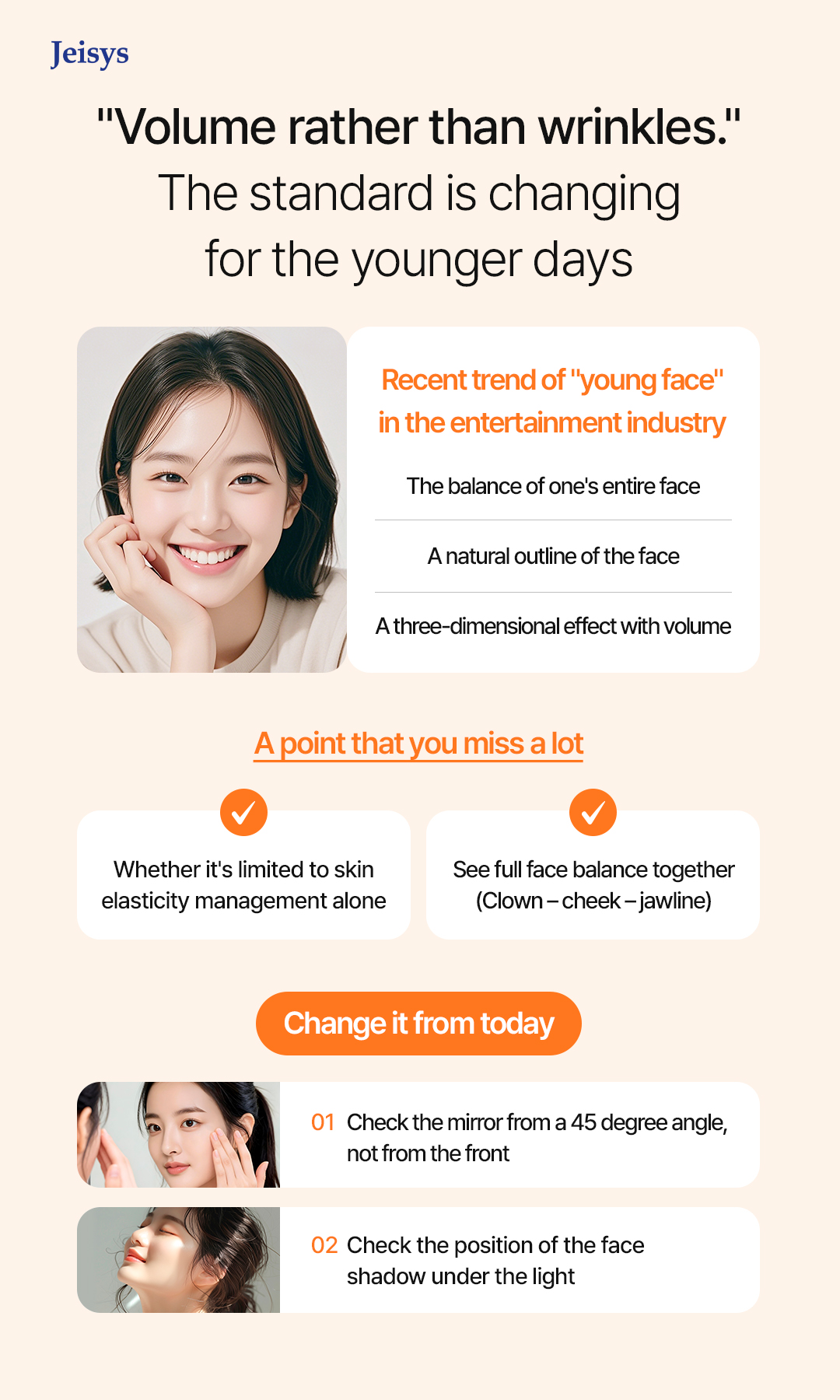
Trend 1. "Volume over Wrinkles" – The Standard for a Youthful Face is Changing
In the past, the standard for a "youthful face" was relatively simple. No facial wrinkles, bright skin tone, and skin with few blemishes were the three representative standards. Therefore, management naturally focused on whitening, skin elasticity, and wrinkle improvement.
However, these days are a bit different. Many people are experiencing that the reason why someone looks much younger while someone else looks more tired even at the same age is not just because of skin condition.
✔ Recent Celebrity "Youthful Face" Trends
- ① Balance of the entire face
- ② Natural facial contours
- ③ Three-dimensionality with living volume
In other words, "how the face looks" has become more important than "having good skin." Therefore, these days, even if skin elasticity has not dropped significantly, if there is a feeling that facial volume has decreased somewhere, people get the impression that they look old more easily.
✔ Points Often Missed
- ① Realize that there is a limit to skin elasticity management alone
- ② Develop a habit of looking at the overall facial balance (cheekbone–cheek–jawline) together
✔ Change Starting Today
- ① Check your mirror from a 45-degree angle instead of from the front (Check three-dimensionality)
- ② Looking at the position of facial shadows under the light is also a good way!
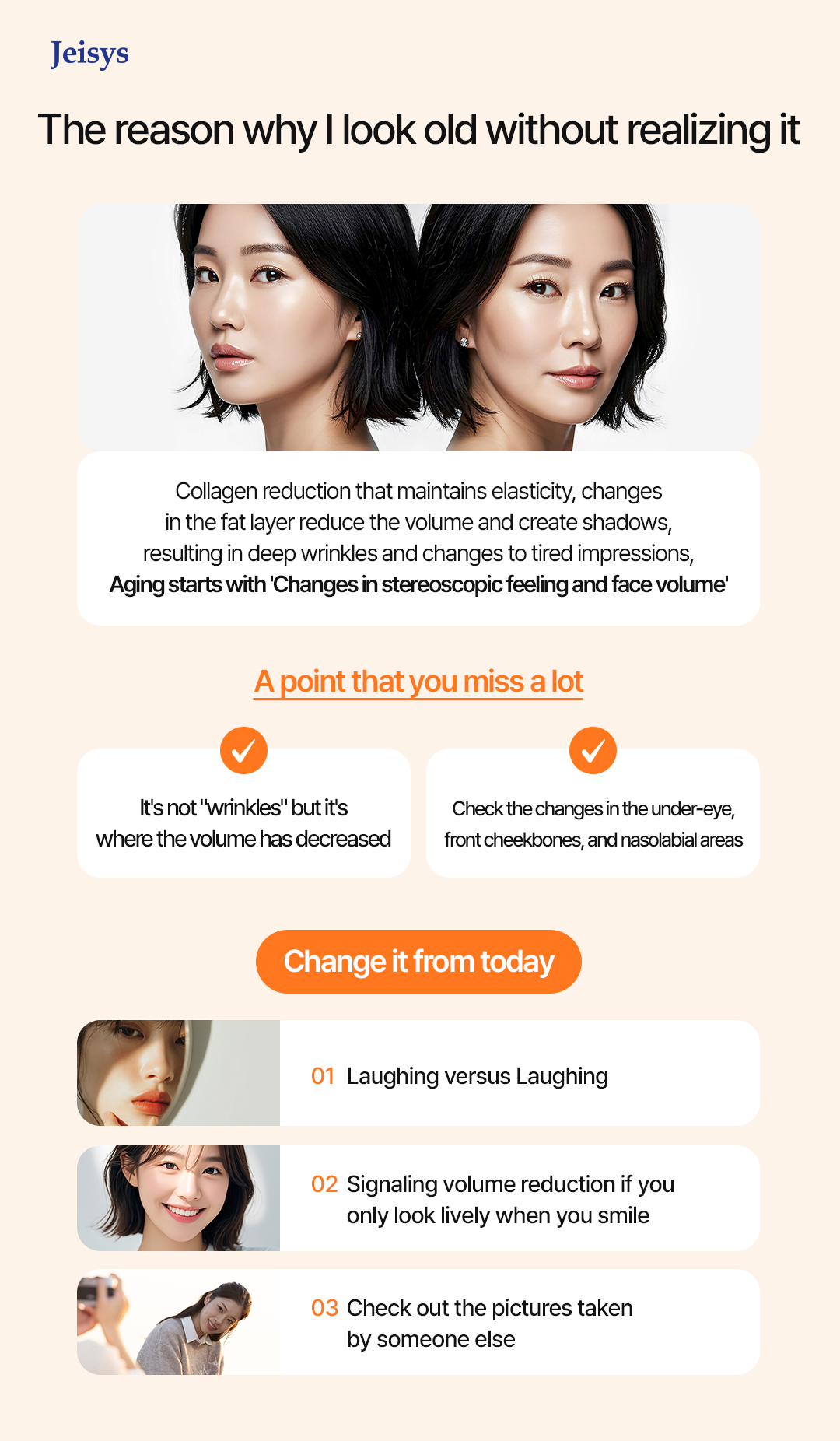
Trend 2. The Reason You Look Old Without Realizing It
Then why does the impression look so different when facial volume decreases? To understand this principle, you must know one thing first: the face is not a plane, but a "three-dimensional structure."
When a face looks young, the facial contours and volume that lead smoothly from the forehead, under the eyes, cheeks, and to the jawline are alive. However, as time passes, changes begin to occur little by little. As collagen reduction that maintains skin elasticity, changes in the fat layer, and decreased skin elasticity overlap, facial volume gradually decreases.
What happens as a result? "Shadows" are created in the places where volume has decreased. The area under the eyes looks darker, the cheeks look flat, facial wrinkles look deeper, and an overall tired impression is created.
The important thing is that all these changes happen very slowly. So you do not feel it yourself, but at some point when you look in the mirror or take a photo, you get the feeling, "Why do I look so different?" Ultimately, aging begins first with "changes in three-dimensionality and facial volume" rather than wrinkles.
✔ Points Often Missed
- ① The key is to look at where the volume has decreased, not that "wrinkles have appeared"!
- ② Especially check for changes under the eyes, front cheekbones, and nasolabial areas
✔ Change Starting Today
- ① Compare your expression when you are not laughing and when you are laughing
- ② If you look lively only when you laugh, it could be a sign of volume loss
- ③ It is more accurate to check with photos taken by others than with selfies
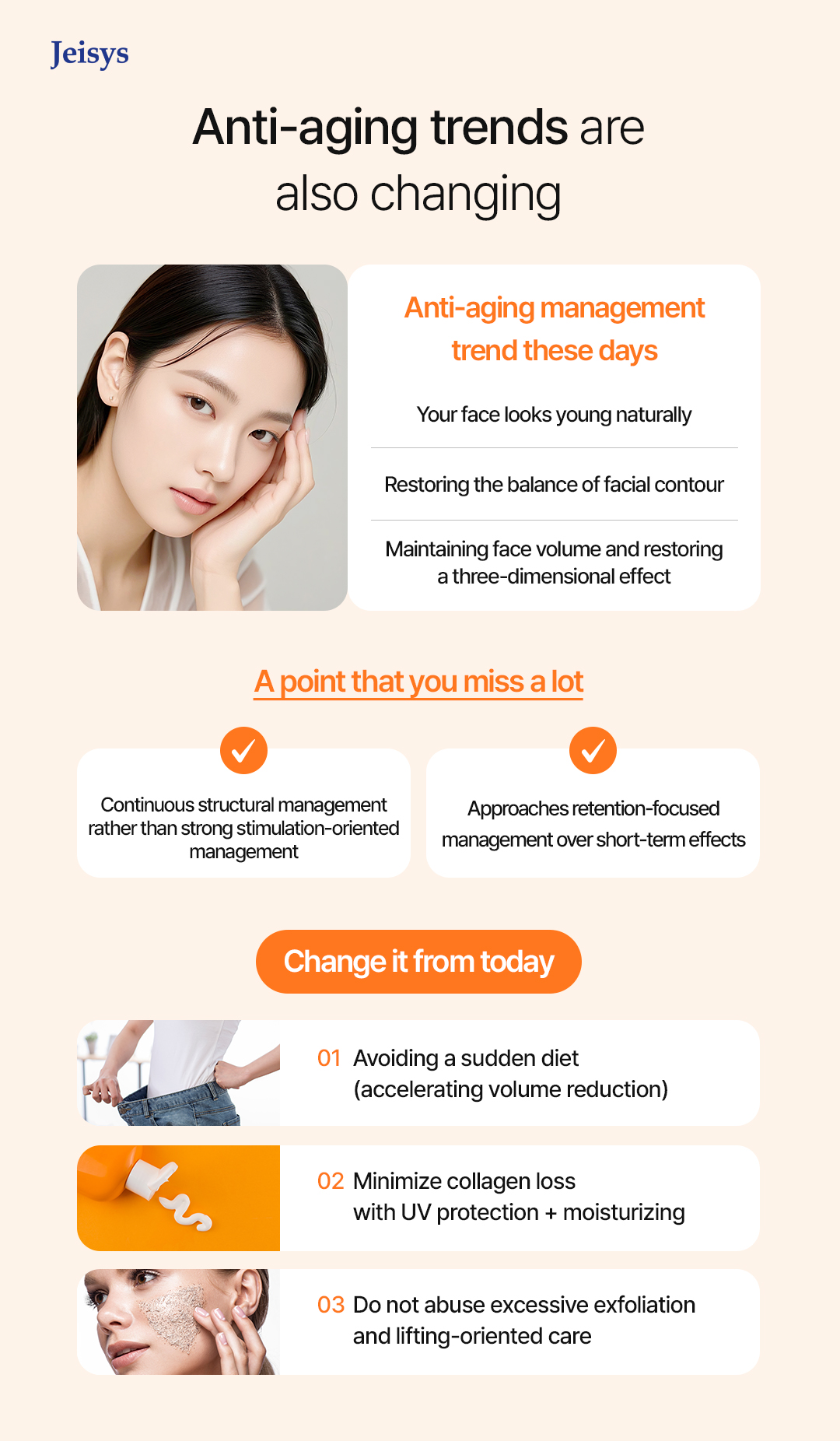
Trend 3. Anti-aging Trends are Also Changing
These changes are naturally affecting the way we manage skin. In the past, if management centered on alleviating already visible problems like whitening, skin elasticity management, and facial wrinkle improvement, recently it has been moving in a slightly different direction.
✔ Recent Anti-aging Management Trends
- ① A youthful face that naturally looks young
- ② Restoring facial contour balance
- ③ Maintaining facial volume and restoring three-dimensionality
Now, the flow is changing to thinking about "how to fill" rather than "how to remove." Because many people now know: it is difficult to completely return to your previous impression just by simply brightening the skin or reducing facial wrinkles!
✔ Points Often Missed
- ① Continuous structural management is more important than management focused on strong stimulation
- ② You must approach it with management centered on persistence rather than short-term effects
✔ Change Starting Today
- ① Avoid rapid dieting (Accelerates volume loss)
- ② Minimize collagen loss through UV protection + moisturizing
- ③ Avoid abusing excessive exfoliation or lifting-oriented management
So recently, "management that fills from the inside to maintain facial volume and skin elasticity" has become more important than management that tidies up the "outside" of the skin. A face with maintained facial volume looks much more lively even at the same age and naturally gives the feeling of a youthful face.
Conversely, if you look tired and old somewhere even though skin elasticity has not dropped significantly, the reason is highly likely to be the loss of facial volume and changes in facial contours that have progressed unnoticeably. Now, skincare must go beyond just making it look good on the outside and think together about how to maintain facial contours, volume, and skin elasticity.
If you have felt that "for some reason, your impression looks different" lately, it might not be a simple mood, but a signal of change sent by your face.